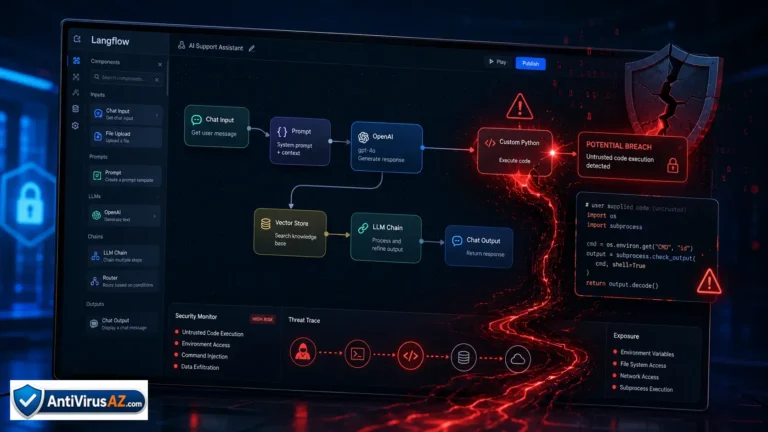
AI is helpful, but it can also be abused
Artificial intelligence is changing the internet fast, and not all of that change is positive. The same tools that help people write, research, translate, automate tasks, and improve productivity can also be used by cybercriminals to make online threats more effective. Instead of sending poorly written scam emails or obvious fake messages, attackers can now use AI to create more convincing phishing emails, realistic fake websites, cloned voices, and highly personalized scams. (Microsoft)
What makes this especially dangerous is that AI often does not create an entirely new kind of cybercrime. Instead, it improves the old ones. A phishing message can sound more natural. A fraud attempt can include personal details pulled from public sources. A scammer can imitate the tone of a company, manager, or public official with far less effort than before. Microsoft has warned that AI-powered deception is helping scammers build more believable fraud campaigns, while Europol says cybercriminals are using AI to support social engineering, attack automation, and more scalable attacks. (Microsoft)
Law enforcement is already seeing this in practice. The FBI warned in 2025 that malicious actors used AI-generated voice messages and text-based impersonation to target people by pretending to be senior U.S. officials. That is a strong sign that the malicious use of AI is not a future problem. It is a current internet security issue affecting both individuals and organizations. (Federal Bureau of Investigation)
In this post, we will look at what malicious use of AI means, how criminals are using it today, why it matters, and what practical steps can help reduce the risk.
Table of Contents
What “malicious use of AI” means
Malicious use of AI means using artificial intelligence tools or AI-generated content to deceive, manipulate, steal, disrupt, or gain unauthorized access. In plain terms, it is what happens when the same technology used for writing, automation, search, or productivity is turned toward fraud, cybercrime, or abuse. That can include generating phishing emails, cloning voices, creating fake images or videos, building scam websites, or helping criminals research and target victims more efficiently. Microsoft’s latest threat intelligence reporting says that most malicious use of AI today is centered on using generative AI to produce text, code, or media that supports criminal activity, while Google notes that threat actors are using AI across parts of the attack lifecycle such as reconnaissance, social engineering, and malware-related tasks. (Microsoft, Google Cloud)
It is also important to understand that malicious AI use does not always mean a fully autonomous “AI hacker” acting on its own. In many real-world cases, AI works more like an accelerator for existing threats. A scammer can use it to write better messages. A fraudster can use it to generate fake identities or persuasive scripts. A cybercriminal can use it to translate lures, summarize stolen data, or debug code more quickly. Europol has warned that large language models are improving the effectiveness of social engineering and helping automate parts of criminal workflows, which makes familiar online threats harder to spot and easier to scale. (Europol IOCTA 2025)
Why AI is changing the threat landscape
AI is changing the threat landscape because it gives attackers a faster, cheaper way to carry out familiar cybercrime tactics at a much larger scale. In many cases, criminals do not need advanced technical skills to benefit from it. They can use generative AI tools to produce convincing emails, realistic scam copy, fake profiles, and polished websites in minutes instead of spending hours creating them manually. Microsoft says AI-powered deception is already helping fraud actors build more believable scams, while Europol reports that large language models are improving the effectiveness of social engineering by tailoring communications and automating parts of criminal workflows. (Microsoft)
Another major shift is personalization. Older scams often relied on generic messages sent to huge lists of people, but AI makes it easier to create content that feels specific and relevant. Attackers can use publicly available information from social media, company pages, or data leaks to shape messages that sound like they were written for one person, one department, or one business relationship. Canada’s National Cyber Threat Assessment says AI is improving the personalization and persuasiveness of social engineering attacks, which means scams can feel more natural and harder to dismiss. (Canadian Centre for Cyber Security)
AI also helps criminals work across more channels at once. A single scam campaign can now include email, text messages, social media messages, fake websites, voice calls, and even synthetic audio or video, all built around the same deceptive story. Microsoft highlights that fraudsters are using AI to create fake storefronts, customer reviews, and business content, while Google’s threat intelligence reporting says adversaries are integrating AI into stages of the attack lifecycle such as reconnaissance, social engineering, and malware development. (Microsoft)
Another reason this matters is that AI makes cybercrime more accessible. Someone who is not especially skilled at writing, coding, or research can still produce professional-looking scam materials with the help of AI tools. That lowers the barrier to entry and allows more attackers to run campaigns that once required more experience or more time. The result is not necessarily a completely new kind of threat, but a version of old threats that is more polished, more scalable, and more convincing. Europol and Google both describe this pattern clearly: threat actors are using AI to improve efficiency, expand reach, and increase the quality of their operations rather than relying only on traditional manual methods. (Europol)
Common malicious uses of AI in cybercrime
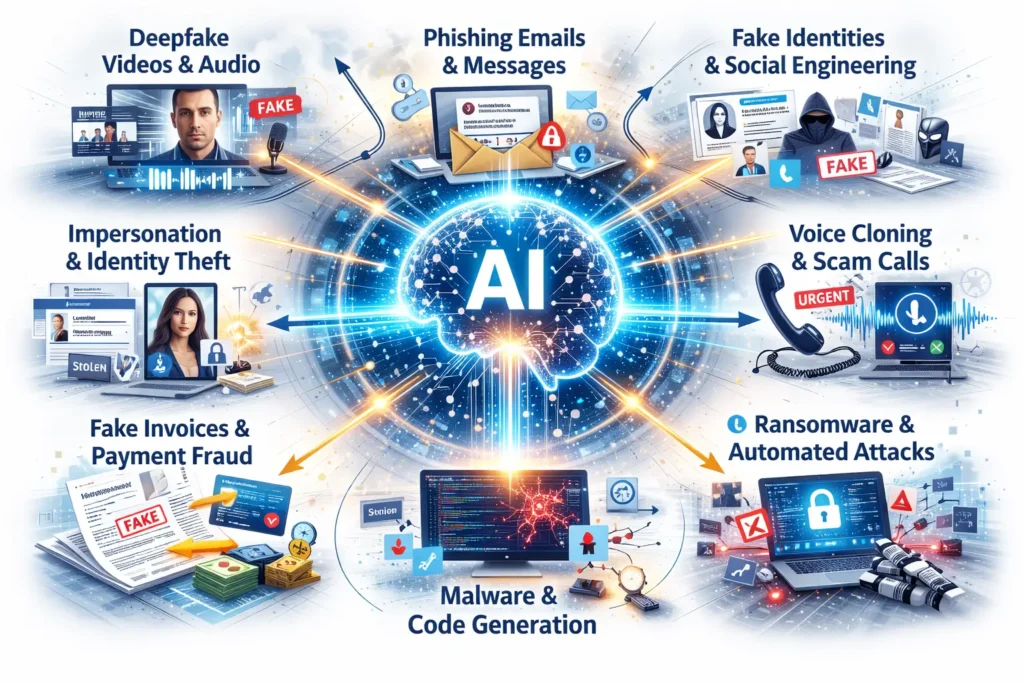
Cybercriminals use AI in ways that feel familiar and new at the same time. The goals often stay the same: steal money, access accounts, trick victims, or spread malware. What changes is the speed, quality, and scale. AI helps attackers create better scams, target people more precisely, and run more polished operations with less effort. Google says threat actors already use AI for research, content generation, translation, coding support, and other steps across the attack chain. Europol also warns that generative AI is making criminal tactics more effective, especially in social engineering and online fraud. (Google Cloud, Europol IOCTA 2025)
AI-generated phishing emails and messages
Phishing remains one of the most common online threats, and AI makes it harder to spot. In the past, many scam emails were easy to dismiss because they had poor grammar, odd phrasing, or obvious formatting issues. Now attackers can use AI to write messages that sound clear, natural, and professional. They can also adjust tone, wording, and detail for a specific person, company, or industry.
This matters because phishing works best when a message feels normal. An email that sounds like a coworker, a bank, or a delivery service can push someone to click before they stop and think. AI also helps criminals create many versions of the same scam in a short time. They can test different subject lines, rewrite messages for different audiences, and translate the same lure into several languages.
The FBI warned in 2025 that malicious actors used text messages and AI-generated voice messages while posing as senior U.S. officials. Their goal was to build trust and move targets to malicious links or other platforms. That case shows how AI can strengthen phishing by making contact feel more personal and more credible. (FBI)
Voice cloning and audio impersonation
Voice cloning is one of the clearest examples of AI-powered deception. Attackers can take short audio samples from videos, interviews, or social media and use them to create speech that sounds like a real person. They may pose as a family member, executive, public official, or manager. Then they use urgency to pressure the victim into acting fast.
These scams often ask for money, gift cards, account access, or private information. Some try to trigger panic. A caller may claim there is an emergency, a missed payment, or a legal problem that needs immediate action. Because the voice sounds familiar, the victim may trust it before checking the facts.
Canadian anti-fraud authorities warned in 2025 that criminals were using AI-generated voice messages to imitate well-known public figures and senior officials. The FBI issued a similar warning in the United States. These alerts make one point very clear: a familiar voice is no longer proof of identity. (Canadian Anti-Fraud Centre, FBI)
Deepfake video and image deception
AI can also create fake images and videos that support fraud and impersonation. A criminal may use a synthetic profile photo to build trust on social media, dating apps, or business platforms. They may also create fake video content that appears to show a real person saying or doing something they never did.
This kind of deception can support many types of crime. It can help with identity fraud, recruiting scams, fake endorsements, and disinformation. In business settings, it can make a fake applicant or fake executive communication seem more believable. It can also help criminals bypass weak identity checks that rely too heavily on visual proof.
Europol has warned that AI-generated media is making impersonation more realistic and easier to scale. That is a serious problem because people often trust what they see, especially when the content looks polished and emotionally convincing. (Europol)
AI-generated fake identities and profiles
AI makes it easier to create fake people who look real enough to pass a quick check. A scammer can generate a profile photo, write a believable bio, and create posts or messages that seem natural. They can then use that fake identity to approach targets, build trust, and support fraud over time.
These profiles appear across many platforms. Some show up on professional networks and job sites. Others appear on marketplaces, social media, or messaging apps. A fake identity may support romance scams, investment scams, job fraud, or account takeovers. In some cases, criminals use several synthetic profiles at once to make a scam look more legitimate.
The danger here is not just the fake image. It is the full package. AI helps attackers create the language, background story, and ongoing conversation that make a false identity feel real. Google’s threat intelligence reporting notes that adversaries use AI for content generation and social engineering tasks, which fits directly with this type of abuse. (Google Cloud)
AI-assisted online fraud and fake websites
Online fraud also becomes more effective when criminals use AI to create polished websites and convincing business content. A fake store no longer has to look sloppy. Attackers can use AI to write product descriptions, return policies, customer reviews, company histories, and support replies that sound professional.
That makes scam websites harder to spot at a glance. A fake business can appear established even when it has no real staff, no real inventory, and no real customer service. Attackers may also create fake comparison pages, promotional emails, and chatbot-style interactions to keep the scam consistent across every touchpoint.
Microsoft says scammers are using AI to generate fake storefronts, fake reviews, and fake business narratives to make fraud look legitimate. That matters because many people still judge trust by appearance. A cleaner site and better writing can make a scam seem safe when it is not. (Microsoft)
AI support for malware and cyberattacks
AI does not need to build fully autonomous malware to help cybercriminals. It can still add value in smaller but important ways. Attackers can use it to draft code, clean up scripts, summarize stolen information, translate instructions, or research targets. These tasks save time and help less skilled criminals do work that once took more expertise.
AI can also support ransomware and intrusion activity behind the scenes. A group may use it to improve phishing lures, organize stolen data, or troubleshoot technical problems during an attack. The victim may never see that AI was involved, but it can still make the operation run more smoothly.
Canada’s Cyber Centre says ransomware actors will likely keep using advances in AI. Google also reports that threat actors are experimenting with AI across the attack lifecycle, including coding and reconnaissance tasks. This does not mean AI now replaces human attackers. It means AI can make them faster, more efficient, and more adaptable. (Cyber Centre Canada, Google Cloud)
AI-driven social engineering at scale
Social engineering works by exploiting trust, urgency, and emotion. AI strengthens all three. Attackers can use it to write better scripts, reply more smoothly in chats, and keep a scam sounding consistent from the first message to the final request. That makes deception easier to sustain.
It also helps criminals scale their efforts. One attacker can generate many versions of a scam for different people, companies, or countries. They can adapt the same story for email, text, direct messages, and voice notes without doing all the writing by hand.
Europol says large language models are improving the effectiveness of social engineering and automating parts of criminal workflows. That may be the simplest way to understand malicious AI use today. In many cases, AI does not replace the scam. It makes the scam work better. (Europol IOCTA 2025)

Real-world risks for everyday users
AI-driven cybercrime does not only threaten large companies or public figures. It also affects ordinary people in very direct ways. In many cases, the risk comes from familiar scams that now look or sound more believable. A phishing email may read like a real message from your bank. A text may sound like a delivery update. A phone call may seem to come from someone you know. The core trick is not new, but AI helps criminals present it in a more convincing way. Canada’s National Cyber Threat Assessment says AI is improving the persuasiveness and personalization of social engineering attacks, which raises the risk for everyday internet users. (Cyber Centre Canada)
Account theft and credential scams
One major risk is account theft. Criminals use AI to create phishing messages that look cleaner and feel more trustworthy. That can lead people to hand over passwords, login codes, or other sensitive details. Once attackers get access to an email account, shopping account, or bank login, they can often use it to cause more damage.
Financial fraud and payment scams
Financial loss is another serious threat. AI can help scammers write convincing payment requests, fake invoices, or urgent fraud messages. It can also support voice-cloning scams that pressure victims to send money before they verify the story. Microsoft warns that AI-powered deception is helping fraud actors build more polished scams and fake online businesses. (Microsoft)
Privacy loss and personal exposure
Everyday users also face privacy risks. Attackers can use public posts, short videos, job details, and other online content to personalize scams. The more information people share online, the easier it becomes for criminals to build messages that feel real. Even small details can help support a targeted scam.
Emotion-based manipulation
AI also makes emotional scams more effective. A cloned voice or highly believable urgent message can push someone to act out of fear, panic, or sympathy. The FBI’s 2025 warning about AI-generated voice impersonation shows how attackers use trust and urgency together to manipulate victims. (FBI)
The key point is simple: everyday users are targets because trust is easy to exploit. AI helps criminals fake trust faster, and that makes common online threats harder to ignore and harder to detect.
Why businesses should care
Businesses face a different version of the same problem. Attackers often target companies where trust moves quickly and small mistakes carry a high cost.
A fake message to a finance team can trigger a wire transfer. In some cases, the request looks routine enough that staff approve it before noticing the account details have changed. A fake applicant can slip into a hiring process. That can expose the company to fraud, internal data theft, or even unauthorized access to systems and devices. A fake vendor email can redirect payments or expose sensitive data. It can also damage trusted business relationships when the fraud is discovered too late.
AI makes these attacks easier to build and harder to spot because the content looks polished and the story feels believable. Microsoft says AI-powered deception is helping fraud actors create more convincing scams, fake storefronts, and false business narratives. (Microsoft)
Payment fraud and executive impersonation
Finance teams face one of the biggest risks. Criminals can use AI to write realistic payment requests or clone a senior executive’s voice. They may claim a payment is urgent, confidential, or tied to a time-sensitive deal. If the team relies on tone, familiarity, or speed, the scam has a better chance of working.
HR and recruiting fraud
HR departments also face growing pressure. A fake applicant can use AI-generated content to create a polished resume, a believable cover letter, and even a convincing profile photo or video presence. That can make fraud harder to detect during early screening. In some cases, attackers may use the hiring process to gain access to company systems, devices, or internal information.
Customer trust and brand abuse
Businesses also risk damage to their brand. Criminals can create fake websites, fake customer service messages, and fake product pages that imitate a real company. They can also build scam campaigns around a trusted brand name. Europol warns that AI is improving social engineering and helping criminals scale deception, which makes brand impersonation more effective. (Europol IOCTA 2025)
Operational and security costs
The impact goes beyond one scam. Businesses may face financial loss, legal exposure, customer distrust, and internal disruption. Teams also need more time to verify requests that once seemed routine. That is why companies should treat malicious AI use as a real security issue, not just a fraud trend. When deception becomes cheaper and faster, businesses need stronger checks and slower approval paths for high-risk actions.
Warning signs of AI-powered scams
AI-powered scams often look polished, but they still follow familiar patterns. The wording may be better. The voice may sound real. The website may look professional. Even so, the scam usually pushes the victim toward the same end point: money, account access, personal data, or a rushed decision. Microsoft says AI is helping fraud actors create more believable scams and stronger deception at scale. Europol also warns that AI is improving social engineering by tailoring communication and automating parts of criminal workflows. (Microsoft)
Unusual urgency
Urgency remains one of the biggest warning signs. A scammer may claim there is a payment problem, a legal issue, an emergency, or a deadline that cannot wait. The goal is simple: make you act before you verify. That tactic appears in both old scams and newer AI-enhanced ones. The language just sounds more natural now. (Microsoft)
Requests for money, passwords, or codes
Be cautious when a message asks for money, login details, reset links, or verification codes. A criminal may frame the request as routine or urgent. They may also pretend to help fix a problem that does not exist. The more pressure they apply, the more careful you should be. The FBI says attackers in a 2025 impersonation campaign used text and AI-generated voice messages to build trust before trying to gain access to personal accounts. (Federal Bureau of Investigation)
Pressure to switch platforms
A scam often becomes more dangerous when the attacker tries to move the conversation somewhere else. That may mean shifting from email to text, from text to WhatsApp, or from a public platform to a private messaging app. The FBI warned that attackers posing as senior U.S. officials used malicious links and tried to move targets to separate messaging platforms. That kind of channel switching is a strong red flag. (Federal Bureau of Investigation)
A familiar voice or polished message that feels slightly off
A message can sound clean and professional and still be fake. A voice can sound familiar and still be synthetic. That is why people should not rely on tone, grammar, or voice alone. Canadian and U.S. authorities have both warned that criminals are using AI-generated voice messages to impersonate trusted figures. When something feels off, even slightly, stop and verify through a known contact method. (Canadian Anti-Fraud Centre)
Emotional pressure and secrecy
Many scams use fear, panic, sympathy, or secrecy to control the victim. The attacker may say, “Handle this now,” or “Do not tell anyone yet.” They may try to isolate the target from normal checks. That pattern matters because AI helps criminals deliver emotional manipulation in more convincing ways, whether by email, text, voice, or video. A polished message is not proof of trust. The behavior behind it matters more. (Microsoft)
How to protect yourself from malicious AI use
The best defense against malicious AI is not panic. It is verification, strong account security, and slower decisions when something feels urgent. AI can make scams look polished, but it does not remove the need for criminals to trick people into acting. That means practical habits still work. Microsoft’s guidance on AI-powered deception focuses on anti-scam protections and stronger fraud defenses, while Canada’s Cyber Centre says core cyber hygiene such as updates, multifactor authentication, backups, and caution around phishing still make a real difference. (Microsoft)
Verify through a second channel
Do not trust a message, call, or voice note just because it sounds familiar. If someone asks for money, account access, private files, or urgent help, verify the request another way. Call a known number. Start a new email. Contact the person through a trusted channel you already use. This step matters because AI can fake tone, grammar, and even voice, but it cannot easily survive independent verification. (Microsoft)
Use multifactor authentication
Strong passwords still matter, but they are not enough on their own. Turn on multifactor authentication for email, banking, cloud storage, and other important accounts. If a phishing scam steals a password, MFA can still block the attacker from logging in. Canada’s Cyber Centre specifically recommends MFA as part of basic cyber hygiene that helps reduce harm from modern threats. (Canadian Centre for Cyber Security)
Slow down urgent requests
Scammers rely on speed. They want the target to react before thinking. That is why it helps to pause when a message pushes urgency, secrecy, or fear. A rushed payment request, a surprise password reset, or an emotional plea for help should always trigger extra checks. The more urgent the message feels, the more carefully it should be verified. Microsoft’s fraud guidance stresses countermeasures that help interrupt scam flow rather than letting urgency drive decisions. (Microsoft)
Limit what you share publicly
Attackers often build better scams with public information. Job titles, family details, travel plans, voice clips, and short videos can all help them personalize a message or clone a voice. You do not need to disappear from the internet, but it helps to be selective. Share less than you think you need to, especially when the information could support identity, trust, or authority.
Use layered security tools
Good habits work best with technical support. Keep devices and apps updated. Use reputable security software. Let your browser warn you about suspicious sites. Turn on account alerts where possible. Back up important files. Canada’s Cyber Centre says regular updates, backups, and phishing awareness still form a strong baseline for defense even as threats evolve. (Canadian Centre for Cyber Security)
Secure AI tools inside the business
Organizations that use AI should also secure the tools themselves. OWASP’s guidance for LLM applications highlights risks such as prompt injection, insecure output handling, training data poisoning, model denial of service, and supply chain vulnerabilities. That means companies should treat AI systems like any other business-critical technology: review access, validate outputs, control integrations, and monitor for abuse. (OWASP Foundation)
The main takeaway is simple: malicious AI works best when people trust too quickly. Strong checks, clear routines, and basic cyber hygiene still stop many attacks before they become serious.
How businesses can reduce the risk
Businesses cannot stop every scam attempt, but they can make those attacks much harder to pull off. The strongest defense is a mix of clear verification rules, employee awareness, and layered security controls. That matters even more now because AI helps attackers produce better phishing messages, more believable fraud, and more polished impersonation attempts. Microsoft says organizations need stronger fraud defenses and anti-scam protections as AI-powered deception grows. Canada’s Cyber Centre also stresses that basic cyber hygiene still matters, including updates, MFA, backups, and caution around phishing. (Microsoft, Cyber Centre Canada)
Update employee training
Security training should cover more than poorly written phishing emails. Staff should learn how AI can improve scam quality across email, text, voice, video, and fake websites. They should also know the warning signs: urgency, secrecy, payment pressure, channel switching, and requests for codes or credentials. Training works best when it uses realistic examples instead of generic reminders.
Add verification steps for sensitive actions
High-risk actions need extra checks. That includes wire transfers, payroll changes, vendor updates, password resets, and requests for confidential files. Teams should verify these requests through a second channel and use known contact details, not the information inside the message itself. This simple step can block many impersonation scams.
Tighten hiring and vendor checks
HR and procurement teams should treat identity as something to verify, not assume. A polished application, professional profile, or smooth video call is no longer enough on its own. Businesses should confirm candidate identity, review vendor changes carefully, and watch for signs of synthetic profiles or fake documents.
Limit public exposure
Attackers often build better scams with public information. Staff directories, executive bios, org charts, and social posts can all help criminals craft believable messages. Companies should review what they publish and remove details that create unnecessary trust signals or make impersonation easier.
Secure internal AI use
Businesses that use AI tools should secure them like any other critical system. OWASP’s guidance for LLM applications highlights risks such as prompt injection, insecure output handling, training data poisoning, model denial of service, and supply chain vulnerabilities. Companies should control access, review integrations, validate outputs, and monitor for misuse. (OWASP)
The goal is not to remove trust from the workplace. It is to make trust depend on process, not appearance. When AI makes deception easier, strong business routines become even more important.
The future of malicious AI use
The malicious use of AI will likely keep growing, but the next stage is not just “more of the same.” Security and law enforcement reports suggest that attackers will keep using AI to make fraud, phishing, impersonation, and cyberattacks faster, cheaper, and easier to scale. Microsoft says threat actors are already operationalizing AI across the cyberattack lifecycle to increase speed, scale, and resilience. Europol also warns that AI is helping criminal networks automate tasks and improve social engineering. (Microsoft)
More realistic impersonation
One clear trend is that impersonation will keep getting better. Voice cloning, deepfake video, and synthetic identities are likely to become more convincing and more accessible. That means people and businesses will need to trust appearances less and verification processes more. INTERPOL’s March 2026 financial fraud assessment says AI-enhanced fraud already includes cloned voices, impersonation fraud, and other schemes built around deception at scale. (Interpol)
More automation in fraud campaigns
Another likely shift is greater automation. Today, many AI-enabled scams still need human direction. In the future, criminals may automate more of the workflow, from writing messages to adapting responses and running follow-up steps. INTERPOL warns that agentic AI can autonomously plan and execute fraud campaigns from start to finish. Europol has also raised concern about increasingly autonomous systems supporting criminal activity. (Interpol)
Defenders will use AI too
The future will not belong only to attackers. Security teams are also using AI to improve detection, triage, and response. That will matter because defense needs to move as quickly as the threats. Microsoft frames this as an ongoing contest: as threat actors operationalize AI, defenders must adapt their controls and mitigation strategies as well. (Microsoft)
The most realistic takeaway is this: AI will not replace cybercriminals, but it will keep making them more efficient. That is why the future of internet security will depend even more on strong verification, layered defenses, and smart habits that do not rely on whether a message, voice, or video looks real.
The Real Lesson: Verify Before You Trust
The malicious use of AI is not a distant or theoretical problem. It is already changing how scams, phishing, fraud, and impersonation work online. Criminals are using AI to write better messages, build more convincing fake identities, clone voices, and scale old tactics in new ways. The result is a threat landscape where deception looks more polished and feels more believable.
Still, the core lesson has not changed. Most of these attacks succeed when people act too quickly, trust appearances, or skip verification. That is why strong habits still matter. Verify unusual requests. Be cautious with urgent messages. Protect important accounts with multifactor authentication. Do not assume a polished email, familiar voice, or realistic video is genuine. Trust less at first, and verify more before you act.
For businesses, the same rule applies at a larger scale. Clear approval steps, better employee training, and stronger identity checks can stop many AI-enhanced scams before they cause real damage. For everyday users, simple caution and good cyber hygiene still go a long way.
AI will keep evolving, and so will the threats built around it. But that does not mean people are powerless. The most effective response is not fear. It is awareness, verification, and practical security habits that make deception harder to turn into harm.