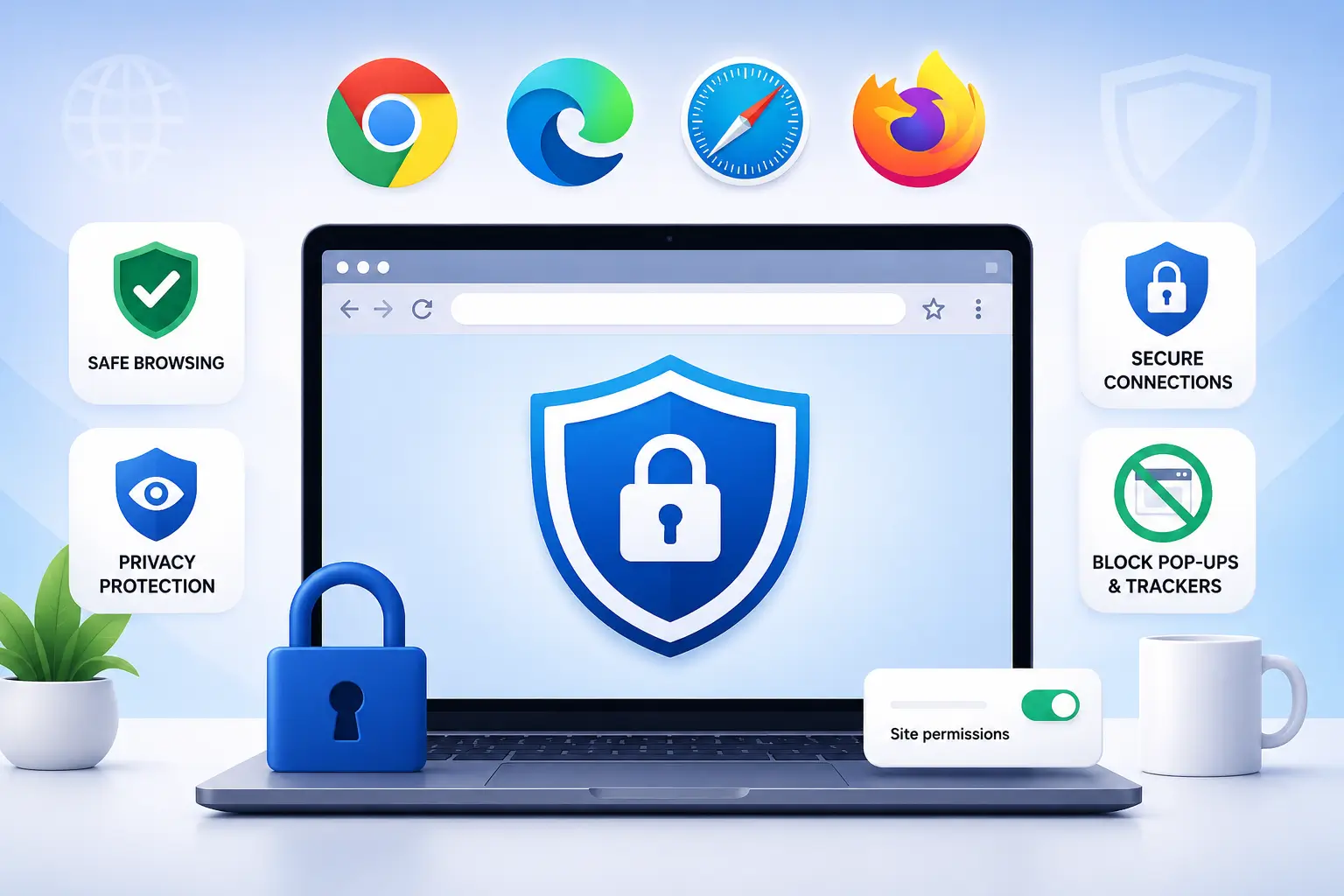
Your web browser is one of the most important apps on your device. It handles email, passwords, payments, downloads, and a lot of personal data. It is also where many everyday threats begin. Phishing sites, fake downloads, harmful extensions, abusive notifications, and suspicious redirects often reach people through the browser first.
The good news is that browser security does not need to be complicated. Small settings and simple habits can make a big difference. Google, Microsoft, Apple, and Mozilla all include built-in protections in their browsers, but those tools work best when people review them, update them, and use them properly. Chrome offers Safety Check, Edge includes Tracking Prevention and Microsoft Defender SmartScreen, Safari includes fraudulent website warnings, and Firefox includes Enhanced Tracking Protection.
This guide covers Chrome, Edge, Safari, and Firefox and focuses on practical browser security steps that everyday users can actually follow. The goal is not perfect privacy or advanced hardening. It is safer browsing with less risk and fewer avoidable mistakes.
Table of Contents
What Browser Security Basics Actually Means
Browser security basics means reducing the most common risks people face while using the web. It is not about turning your browser into a locked-down technical project. It is about making everyday browsing safer by managing the settings and habits that matter most.
In practical terms, that usually means keeping the browser updated, checking saved passwords, removing extensions you do not use, reviewing site permissions, watching for suspicious notifications, and paying attention to warning pages. These steps help reduce common problems such as phishing, risky downloads, extension abuse, unwanted tracking, and permission misuse.
Each major browser already includes tools that support this kind of maintenance. Chrome includes Safety Check, which reviews passwords, browser updates, safe browsing status, harmful extensions, and unwanted notifications. Edge includes Tracking Prevention, Password Monitor, and Microsoft Defender SmartScreen. Safari includes fraudulent website warnings and privacy controls tied closely to Apple’s software updates. Firefox includes Enhanced Tracking Protection with Standard, Strict, and Custom modes.
The main goal is simple. Browser security basics helps you browse, log in, download, and shop online with fewer risks and fewer bad surprises. It is not about doing everything at once. It is about keeping a few important browser settings under control and reviewing them often enough that small problems do not go unnoticed.
Core Browser Security Habits for Everyone
Some browser security habits matter no matter which browser you use. Whether you prefer Chrome, Edge, Safari, or Firefox, the same basic routine helps reduce everyday risks and keeps your browser safer over time.
Keep your browser updated
Browser updates are one of the easiest and most important security steps. Browsers receive frequent fixes for vulnerabilities, unsafe behavior, and new web-based threats. If you delay updates for too long, you leave the browser exposed longer than necessary. Google, Apple, Microsoft, and Mozilla all treat updates as a core part of browser security.
Review saved passwords
A secure browser still depends on secure accounts. If weak or reused passwords are saved in the browser, they can undermine everything else. It is a good idea to review saved passwords from time to time, remove old ones you no longer need, and watch for alerts about compromised credentials. Chrome Safety Check and Microsoft Edge both include password-related safety tools that help users spot problems.
Remove extensions you do not use
Extensions can be useful, but they also create extra risk. Some can read what you do online, change page content, or collect more data than users realize. Others simply become outdated and forgotten. Keeping fewer extensions installed is usually safer than adding more. Review your extension list regularly and remove anything you do not recognize, do not trust, or no longer use.
Be careful with notifications and site permissions
Many scam sites abuse browser notifications. They ask users to click Allow, then flood them with misleading alerts, fake warnings, or shady ads. Permissions for camera, microphone, location, notifications, downloads, and clipboard access also deserve regular review. Google has added Safety Check help for unwanted notifications, which shows how common this problem has become.
Do not ignore browser warnings
Safe Browsing, SmartScreen, Safari warnings, and Firefox protections exist for a reason. If the browser warns you about a suspicious site, a dangerous file, or a known phishing page, do not click through carelessly. These warnings are one of the most direct ways browsers protect users from common online threats.
Restart and review your browser once in a while
Browsers collect clutter over time. Tabs pile up, extensions stay installed, permissions get forgotten, and settings drift. A simple review every month or two helps keep the browser cleaner and easier to trust. That does not mean resetting everything. It just means checking the basics often enough that small problems do not sit there for months.
These habits work because they are simple and repeatable. You do not need an advanced browser setup to browse more safely. You need a few good habits that you actually keep doing.
Browser settings are only one part of staying safe.
For a wider look at keeping your devices secure over time, read our guide to basic security maintenance for computers, phones, and tablets.
Chrome Security Basics

Chrome includes several built-in tools that make browser security easier to manage, but they only help if users know where to look and what to review. For most people, the best place to start is Safety Check. Google says Safety Check reviews important areas such as compromised passwords, browser updates, Safe Browsing status, harmful extensions, and abusive notification permissions. It can also run in the background and alert users when something needs attention.
Another important habit is reviewing site permissions. Over time, many users allow websites to access notifications, location, camera, or microphone without thinking much about it. That can create clutter and sometimes real risk. In Chrome, it is worth checking which sites still have access and removing permissions you no longer want to keep.
Extensions deserve extra caution in Chrome because they can change how the browser behaves and access what you do online. Even useful extensions can become a problem if they are abandoned, overly invasive, or simply forgotten. A shorter extension list is usually a safer extension list. If you do not remember why you installed something, that is already a good reason to review it.
Chrome’s Safe Browsing protections also matter. Google says Safe Browsing helps protect users from dangerous sites, downloads, and extensions. That makes it one of the most important built-in safety features in the browser. If Chrome shows a warning page, the safest response is usually to stop and reassess, not click through automatically.
The practical takeaway is simple. Chrome is already equipped with helpful security features, but the browser is safest when users actually check them. Run Safety Check, review permissions, keep extensions under control, and do not ignore Safe Browsing warnings.
Edge Security Basics

Microsoft Edge includes several built-in protections that make everyday browsing safer, especially for users who take a few minutes to review the settings. One of the most important is Tracking Prevention. Microsoft says Edge offers Basic, Balanced, and Strict modes, with Balanced set as the recommended option for most users because it blocks many trackers while keeping websites working normally.
Another key feature is Microsoft Defender SmartScreen. Microsoft says SmartScreen helps protect users from phishing sites, malicious pages, and suspicious downloads. That makes it one of the most valuable built-in protections in Edge. If Edge warns you that a site or file looks risky, that warning deserves attention. Clicking through too quickly defeats one of the browser’s most useful security features.
It is also worth reviewing Password Monitor and other account-related safety tools inside Edge. Microsoft includes password security features that can alert users when saved credentials may have been exposed, which helps turn the browser into more than just a place where passwords sit quietly in storage.
Like any browser, Edge also needs regular permission cleanup. Check which sites have access to notifications, location, camera, microphone, downloads, and clipboard access. Over time, these settings can fill up with approvals you no longer remember granting. Removing old permissions is a simple way to make the browser cleaner and safer.
The practical takeaway with Edge is straightforward. Leave Tracking Prevention on, use SmartScreen as intended, check password warnings, and review permissions every so often. For most users, those few habits cover the most important browser security basics in Edge.
Safari Security Basics

Safari’s security strengths are closely tied to the wider Apple ecosystem. That means one of the most important Safari habits is also one of the simplest: keep your Apple devices updated. Safari security improvements often arrive through macOS, iPhone, and iPad updates, so delaying system updates can also mean delaying browser protections. Apple’s security guidance makes that connection clear by treating browser safety as part of the broader platform security model.
Another important setting is fraudulent website warning. Apple says Safari can warn users when they visit a suspected phishing website, which makes this one of the browser’s most useful everyday protections. Like similar warnings in other browsers, it only helps if users take it seriously and avoid clicking through carelessly.
Safari users should also review privacy settings and website data from time to time. Over time, browsers collect cookies, stored site data, and permissions that users may forget about. It is worth checking which sites still have access to things like camera, microphone, location, and notifications, then removing anything you no longer want to allow. Apple’s Safari guidance also supports reviewing website data and privacy-related settings as part of safer browsing.
Private Browsing can help in some situations, but it should be understood realistically. It helps keep local browsing activity from being stored in the usual way on the device, but it does not make a person invisible online or replace safe browsing habits. Safari is safest when users combine its privacy tools with regular updates, cautious permission use, and attention to website warnings.
The practical takeaway is simple. Keep Apple devices updated, leave fraudulent website warnings on, review site permissions, and clean up website data once in a while. Those small habits go a long way toward making Safari safer for everyday use.
Firefox Security Basics

Firefox stands out most for its built-in privacy and tracking controls. The main feature to know is Enhanced Tracking Protection. Mozilla says Firefox offers Standard, Strict, and Custom modes. For most people, Standard is the best starting point because it blocks many common trackers while keeping websites working normally. Strict can provide stronger privacy, but it may also break some site features, which makes it better for users who are comfortable adjusting settings when needed.
Another useful Firefox habit is understanding how it handles cookies and cross-site tracking. Mozilla says Firefox blocks many cross-site tracking cookies by default as part of its tracking protection. In practical terms, that helps reduce the ability of advertisers and other trackers to follow users across different sites. It does not remove every kind of tracking, but it does give Firefox a strong privacy-focused foundation.
Firefox users should also expect that stronger protection can sometimes affect how a website behaves. That does not mean the browser is broken. It usually means a privacy feature is blocking something the site expected to load. Firefox allows users to manage exceptions when needed, which is useful for people who want stronger protection without losing access to important sites.
Extensions still matter in Firefox just as much as they do in Chrome or Edge. A privacy-focused browser can still become risky if it fills up with old, intrusive, or poorly maintained add-ons. Reviewing extensions regularly and keeping only the ones you trust is one of the simplest ways to make Firefox safer.
The practical takeaway is simple. Use Enhanced Tracking Protection, keep Firefox updated, review exceptions carefully, and keep your extensions under control. That gives most users a strong and realistic Firefox security setup for everyday browsing.
Browser Extensions: One of the Biggest Everyday Risks
Browser extensions can be genuinely useful. They can block ads, save passwords, organize tabs, check grammar, or connect the browser to other services. The problem is that they also sit very close to your browsing activity. In many cases, an extension can read page content, see what you type into websites, change how pages behave, or inject its own content into the browser. That makes extensions one of the biggest everyday browser security risks.
The main danger is not only obviously malicious extensions. It is also old, forgotten, overly broad, or poorly maintained extensions that stay installed long after people stop thinking about them. A tool that seemed harmless a year ago may now be abandoned, sold, updated in a bad direction, or asking for more access than it really needs. That is why extension cleanup matters so much.
A good rule is simple: install fewer extensions, not more. Most people do not need a long list of add-ons. They need a very short list of tools they trust and actually use. If you do not remember why an extension is installed, that is already a good reason to review it. If two extensions do similar jobs, keep the one you trust more and remove the other.
It also helps to pay attention to permissions before installing anything new. If an extension wants broad access to all websites, clipboard data, downloads, or browsing activity, ask whether that access really makes sense for what the extension claims to do. Some access is normal, but overly broad permissions should make users more cautious.
This is one of the easiest browser security wins available to everyday users. A shorter extension list is usually a safer extension list. Review it regularly, remove what you do not need, and avoid installing random extensions just because they look useful in the moment.
Notifications, Pop-Ups, and Site Permissions
Notifications and site permissions are some of the most overlooked browser security settings. Many people click Allow without thinking much about it, especially when a site asks for notifications, location access, camera use, or microphone access. Over time, that can leave the browser full of permissions that no longer make sense or that were never a good idea in the first place.
Browser notifications are a good example. Many scammy or low-quality sites use notification prompts to push fake warnings, misleading offers, shady ads, or links that try to create panic. Once a user clicks Allow, those alerts can keep appearing long after the original site is gone from memory. Google has highlighted this problem directly by expanding Chrome Safety Check to help users review and remove abusive notification permissions.
That is why notification cleanup should be a regular habit. If your browser shows alerts from sites you do not recognize, do not trust, or no longer use, remove those permissions. The same logic applies to other site settings. Review access to camera, microphone, location, clipboard, downloads, and pop-ups from time to time and revoke anything that feels unnecessary.
Pop-ups deserve attention too. While many browsers block harmful pop-ups automatically, some sites still find ways to pressure users into allowing extra windows, fake update messages, or misleading buttons. If a site feels pushy or tries to rush you into clicking, that alone is a warning sign.
The practical takeaway is simple. Do not treat browser permissions like harmless little prompts. They control what websites can do inside your browser. A quick permission review every month or two can remove a lot of clutter and reduce a lot of unnecessary risk.
Suspicious permissions often go hand in hand with scam sites and fake messages.
For a quick way to spot common red flags, read our guide on how to identify phishing emails.
Private Browsing, Tracking Prevention, and What They Really Do
Private browsing is useful, but many people expect too much from it. In simple terms, private browsing mostly stops your browser from saving the usual local history, cookies, and form data in the normal way after the session ends. It can help if you share a device or do not want your browsing activity stored on that device in the usual places. What it does not do is make you invisible online or fully stop websites, networks, or services from knowing you visited them. Apple’s guidance for Private Browsing reflects this more limited role, and the same general idea applies across browsers.
Tracking prevention is different. It focuses on reducing how much websites and third parties can follow you across the web. Microsoft Edge uses Tracking Prevention with Basic, Balanced, and Strict options, while Firefox uses Enhanced Tracking Protection with Standard, Strict, and Custom modes. These tools can block many trackers and cross-site tracking cookies, which helps reduce profiling and unwanted tracking. They improve privacy, but they still do not create total anonymity.
That difference matters because people often mix the two ideas together. Private browsing is mainly about what your browser keeps on your own device after the session. Tracking prevention is mainly about what websites and advertisers can do while you browse. They solve different problems, and both have limits.
For most users, the best approach is practical. Use private browsing when you do not want the session stored normally on the device. Use tracking prevention to reduce unwanted tracking across sites. Then combine both with the habits that matter even more: keeping the browser updated, checking permissions, removing risky extensions, and paying attention to warning pages. These tools help, but they work best as part of a broader browser security routine, not as a substitute for one.
A Simple Browser Security Checklist
If you want the shortest version of this guide, the checklist below turns browser security into a simple routine. You do not need to review every setting every day. You just need to check the right things often enough that small problems do not sit there for months.
| Task | How Often | Why It Matters |
|---|---|---|
| Update the browser | Weekly or automatic | Fixes security vulnerabilities and improves built-in protections |
| Review saved passwords | Monthly | Helps catch weak, reused, or compromised passwords |
| Remove unused extensions | Monthly | Reduces browser attack surface and clutter |
| Review site permissions | Monthly | Limits access to notifications, camera, microphone, and location |
| Clear suspicious notifications | Monthly | Cuts down scams, fake alerts, and unwanted prompts |
| Review privacy and tracking settings | Every few months | Keeps protections aligned with your needs |
| Pay attention to browser warnings | Ongoing | Helps catch risky sites and downloads early |
This kind of checklist works because it keeps browser security manageable. You do not need a complicated setup to browse more safely. You need a short list of habits you can actually repeat over time.
Common Browser Security Mistakes
Many browser security problems do not start with one dramatic mistake. They start with small habits people ignore for too long. A browser may seem “fine” even while it collects risky extensions, bad permissions, weak passwords, and outdated settings in the background.
One of the most common mistakes is ignoring browser updates. Because updates often happen quietly, it is easy to forget they matter. But browsers get frequent security fixes, and delaying those fixes leaves known weaknesses exposed longer than necessary.
Another common mistake is installing too many extensions. People often add extensions for convenience, then forget they are there. Over time, that creates clutter and risk. An old or overly broad extension can become one of the weakest parts of an otherwise secure browser.
Many users also reuse passwords or save weak passwords without reviewing them. That is a major problem because browser safety does not help much if your accounts are easy to take over. A compromised email or password manager account can create damage far beyond the browser itself.
Another frequent mistake is clicking through warnings too quickly. Safe Browsing, SmartScreen, fraudulent site warnings, and similar protections only work if people stop when the browser says something looks dangerous. Treating every warning like an annoyance removes one of the browser’s most useful safety layers.
A lot of people also allow notifications on random sites without thinking much about it. That often leads to fake alerts, scammy messages, and constant browser clutter. The same problem shows up with other permissions too. Camera, microphone, location, and clipboard access can pile up across many sites if nobody reviews them.
Some users assume private browsing means full privacy. It does not. Private browsing mainly limits what gets stored locally after the session ends. It does not make someone invisible online or solve broader tracking and security issues on its own.
Another overlooked mistake is saving sensitive logins on shared devices. Even if the browser is otherwise safe, storing important credentials on a family computer or shared laptop can create obvious risks.
The pattern behind all of these mistakes is simple. People assume browser security is a one-time setup. It is not. A safer browser usually comes from small reviews and small corrections made regularly, not from one big cleanup after something goes wrong.
Warning Signs Your Browser Needs a Cleanup
Sometimes the browser tells you fairly clearly that something is off. The problem is that many people ignore those signs until the browser becomes annoying, confusing, or hard to trust.
One common warning sign is when your homepage, default search engine, or new tab page changes unexpectedly. If that happens and you did not make the change yourself, it often points to an extension, a browser setting change, or software that should be reviewed and removed.
Another sign is too many pop-ups, redirects, or strange tabs opening on their own. Some of this behavior comes from low-quality websites, but repeated redirects or intrusive pop-ups can also suggest bad permissions, unwanted notifications, or an extension that is interfering with normal browsing.
A browser that feels slower than usual can also need attention. Slow performance does not always mean malware, but it can mean too many extensions, too many saved site permissions, too much cached clutter, or background activity you have not reviewed in a long time.
You should also pay attention if unknown extensions appear or if your extension list includes tools you no longer recognize. The same goes for notifications from websites you do not remember allowing. Those are both strong signs that the browser needs a settings review and some cleanup.
Another important warning sign is login or password alerts. If the browser warns you about compromised passwords, unusual sign-in behavior, or suspicious saved credentials, take that seriously. Those alerts may point to an account problem even if the browser itself looks normal.
Repeated security warning pages, suspicious downloads, or sites asking for unnecessary permissions are also signs that your browsing habits or browser settings deserve a closer look. Even if nothing is seriously wrong yet, these are the moments when cleanup is easiest.
The main idea is simple. A browser usually does not become risky all at once. It gets there gradually through clutter, bad permissions, old extensions, and ignored warnings. Catching those signs early makes cleanup easier and browsing safer.
Which Browser Feels Safest for Most People?
There is no single browser that is automatically the safest for everyone. Chrome, Edge, Safari, and Firefox all include strong built-in security features, and for most people the safest browser is usually the one they keep updated, cleaned up, and properly managed. Google highlights Chrome Safety Check and Safe Browsing, Microsoft emphasizes Edge Tracking Prevention and Defender SmartScreen, Apple documents Safari’s fraudulent website warnings and broader platform protections, and Mozilla positions Firefox around Enhanced Tracking Protection and stronger privacy controls.
That said, each browser has a slightly different feel. Chrome is a strong fit for users who want easy safety checkups and a familiar interface. Edge works well for people who want strong built-in safety features tied closely to Microsoft’s ecosystem, especially tools like SmartScreen and Tracking Prevention. Safari makes the most sense for people already deep in the Apple ecosystem, where browser security benefits from Apple’s broader software and device protections. Firefox often feels strongest for users who care more about privacy controls and want clearer tracking-protection choices.
For most everyday users, the practical answer is simple. Choose the browser that feels comfortable to use, then keep it updated, keep extensions under control, review permissions, and pay attention to warnings. A well-maintained browser is usually safer than a “better” browser that gets ignored.
A Safer Browser Starts With a Few Small Habits
Browser security does not need to be complicated to be effective. Most people do not need advanced tools or deep technical knowledge to browse more safely. They need a few simple habits that they can repeat over time.
Keeping the browser updated, checking saved passwords, removing extensions you no longer use, reviewing site permissions, and taking warning pages seriously all make a real difference. None of those steps is dramatic on its own, but together they reduce many of the problems that lead to phishing, suspicious downloads, browser clutter, and account trouble.
That is also why browser security works best as maintenance, not as a one-time setup. A browser may start out clean and safe, but over time it collects extensions, site permissions, saved data, and settings that deserve another look. Small reviews done regularly are often more useful than one big cleanup after something already feels wrong.
Whether you use Chrome, Edge, Safari, or Firefox, the same idea applies. The safest browser is usually not the one with the most hype around it. It is the one that stays updated, managed, and under control.
The easiest place to start is simple: pick one or two habits from this guide and make them regular. A few small browser security habits can prevent a lot of unnecessary risk.
Frequently Asked Questions
What is the safest browser for everyday use?
There is no single browser that is safest for everyone. Chrome, Edge, Safari, and Firefox all offer strong built-in protections. For most people, the safest browser is the one they keep updated, manage carefully, and use with good habits. That means reviewing extensions, checking permissions, paying attention to warnings, and keeping saved passwords under control.
Do browser extensions really create security risks?
Yes, they can. Extensions often get broad access to what you do in the browser. Some can read page content, change websites, track activity, or inject their own content. Even useful extensions can become risky if they are outdated, abandoned, or too invasive. That is why keeping a small, trusted extension list is one of the simplest browser security improvements you can make.
Does private browsing protect me from tracking?
Not fully. Private browsing mostly stops the browser from saving the usual local history, cookies, and form data after the session ends. It does not make you invisible online. Websites, internet providers, workplaces, schools, and other services may still be able to see activity in different ways. Tracking prevention and privacy settings help more with cross-site tracking, but they also do not create total privacy.
How often should I review browser settings?
A quick review once a month is a good habit. That is a good time to check extensions, saved passwords, site permissions, notification settings, and anything that looks unfamiliar. You do not need to do a full browser audit every week. A small review done regularly is usually enough for basic browser security maintenance.
What is the easiest browser security step to start with?
The easiest place to start is keeping your browser updated. After that, the next easiest wins are removing extensions you do not use, checking saved passwords, and reviewing notification permissions. These steps are simple, but they reduce a lot of common browser risk without making the browser harder to use.
References
The information in this article is based on official browser support pages and security feature documentation from Google, Microsoft, Apple, and Mozilla. These sources support the guidance on browser updates, password checks, Safe Browsing and SmartScreen warnings, tracking prevention, private browsing, site permissions, and extension-related safety.
- Google Chrome Help, Safety Check
https://support.google.com/chrome/answer/10468685?co=GENIE.Platform%3DDesktop&hl=en - Google Chrome Help, Update Google Chrome
https://support.google.com/chrome/answer/95414?hl=en - Google Chrome Help, Safe Browsing in Chrome
https://support.google.com/chrome/answer/9890866?hl=en - Google Blog, Chrome Safety Check updates
https://blog.google/products-and-platforms/products/chrome/google-chrome-safety-update-september-2024/ - Microsoft Support, Learn about tracking prevention in Microsoft Edge
https://support.microsoft.com/en-us/edge/learn-about-tracking-prevention-in-microsoft-edge - Microsoft Edge, Security features
https://www.microsoft.com/en-us/edge/features/security - Microsoft Support, What is Microsoft Defender SmartScreen and how can it help protect me?
https://support.microsoft.com/en-us/microsoft-edge/what-is-microsoft-defender-smartscreen-and-how-can-it-help-protect-me-1c9a874b-6824-be5e-45e9-864931d6a4cf - Microsoft Support, Microsoft Edge update settings
https://support.microsoft.com/en-us/microsoft-edge/microsoft-edge-update-settings - Apple Support, Security in Safari on Mac
https://support.apple.com/guide/safari/security-ibrw1074/mac - Apple Support, Browse privately in Safari on iPhone
https://support.apple.com/en-ca/guide/iphone/iphb01fc3c85/ios - Apple Support, Manage cookies and website data in Safari on Mac
https://support.apple.com/en-bn/guide/safari/sfri35610/mac - Apple Support, Apple security updates
https://support.apple.com/en-ca/100100 - Mozilla Support, Enhanced Tracking Protection in Firefox for desktop
https://support.mozilla.org/en-US/kb/enhanced-tracking-protection-firefox-desktop - Mozilla Support, Third-party cookies and Firefox tracking protection
https://support.mozilla.org/en-US/kb/third-party-cookies-firefox-tracking-protection - Mozilla Support, Update Firefox to the latest release
https://support.mozilla.org/en-US/kb/update-firefox-latest-release - Mozilla Support, How does built-in Phishing and Malware Protection work?
https://support.mozilla.org/en-US/kb/how-does-phishing-and-malware-protection-work